Research & Papers
Table of Contents
My research sits at the intersection of computational mechanics, materials science, and high performance computing. The through-line across all of it is a single ambition: to build simulation tools and theoretical frameworks rigorous enough to predict how real materials behave under real conditions, and fast enough to be practically useful at scale.
Research Themes#
The work divides into four areas. The first grew from my PhD work at Cornell, where the central question was how deformation distributes itself heterogeneously within individual crystal grains and how to quantify that using both simulation and experiment. The latter three reflect work where the focus shifted toward making those simulations run on the world’s largest computers, advancing material models, and applying them to the challenge of metal additive manufacturing.
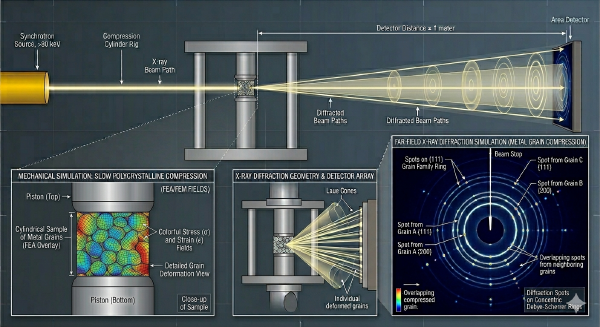
Intragranular Deformation & Crystal Lattice Methods: Developing metrics and finite element methods to characterize how deformation varies within individual grains, bridging high-energy X-ray diffraction experiments with crystal plasticity simulations.
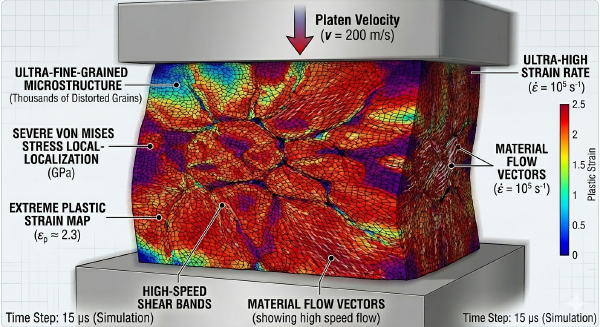
BCC Crystal Plasticity & High Strain-Rate Mechanics: Building physically grounded constitutive models for BCC metals like tantalum, informed by molecular dynamics simulations and validated against dynamic plate-impact experiments.
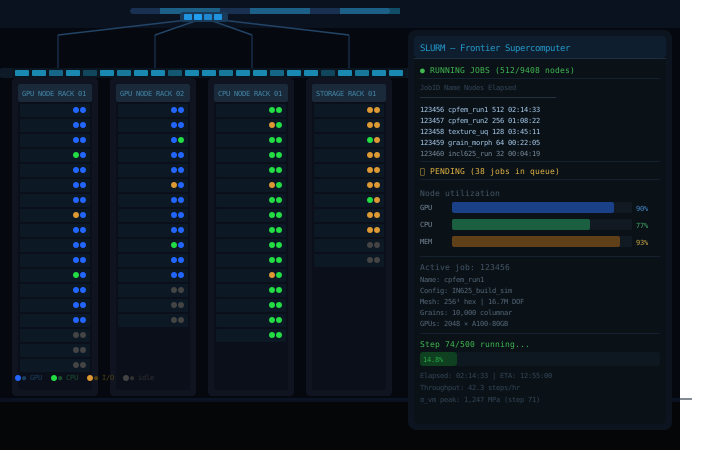
High Performance Computing & GPU-Accelerated Scientific Software: Designing and implementing GPU-friendly algorithms and open-source libraries (including ExaConstit, ExaCMech, and MAGMA) that make large-scale ensemble simulations practical on exascale hardware.
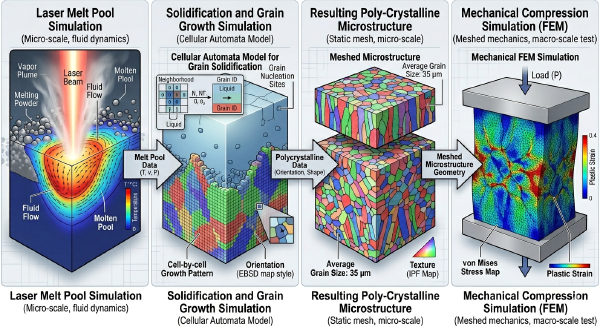
Additive Manufacturing Simulation & Uncertainty Quantification: Applying the ExaAM simulation pipeline from melt pool through microstructure to mechanical properties to predict and quantify uncertainty in metal parts built by laser powder bed fusion.
Early Work#
Prior to my PhD, I contributed to research on biomedical materials, specifically on surface-porous polyether-ether-ketone (PEEK) for orthopedic implants. That work, Evans et al., Acta Biomaterialia (2015), doi:10.1016/j.actbio.2014.11.030, investigated how a thin porous surface layer could be engineered onto high-strength PEEK to promote bone ingrowth without sacrificing the bulk mechanical properties needed for load-bearing applications. It was early exposure to connecting mechanical testing and materials characterization to real outcomes, an approach that continues to shape how I think about validating simulation work.