
Overview#
Metal additive manufacturing, particularly laser powder bed fusion (LPBF), creates a scientific challenge that most manufacturing processes do not: the mechanical properties of the resulting part depend on a cascade of physical processes spanning many orders of magnitude in scale, from the nanosecond laser-material interaction at the melt pool surface, through the solidification dynamics that determine grain nucleation and growth, to the part-scale stress distributions that determine structural performance. The microstructure and therefore the properties vary spatially as a function of local thermal history, which itself depends on laser parameters, scan strategy, part geometry, and proximity to other features.
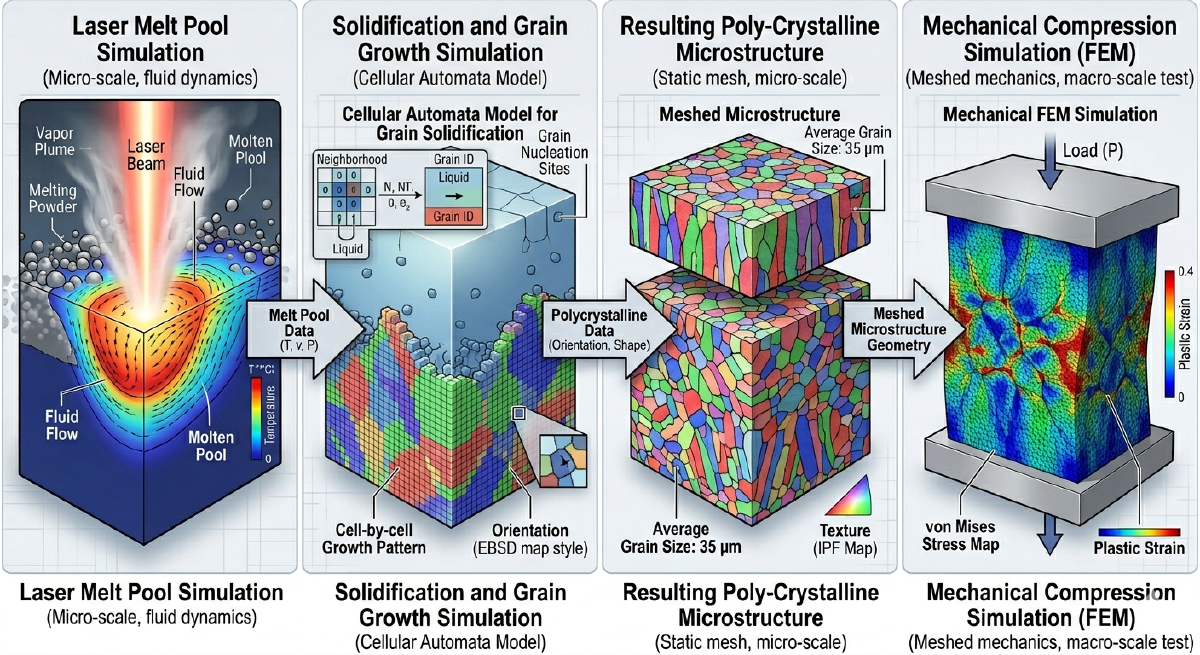
This is precisely the kind of problem that integrated computational materials engineering (ICME) frameworks were designed for. The ExaAM project, a multi-institution effort within the DOE Exascale Computing Project, built a production implementation of that vision for LPBF: a linked simulation pipeline connecting melt pool thermodynamics, solidification microstructure evolution, and crystal plasticity finite element analysis into a single end-to-end predictive framework.
The scientific problem driving this pipeline is certification. For safety-critical applications, you need to know the local mechanical properties of a printed part before you have tested thousands of them. Physical testing alone cannot characterize the spatial variability efficiently; the combinatorial explosion of alloy, process, and geometry combinations makes empirical database approaches impractical for new materials or machine configurations. A physics-based simulation pipeline that is sufficiently validated breaks this dependence and allows meaningful property predictions with far fewer physical experiments.
Getting there requires more than fast simulations. A full uncertainty quantification study over processing parameter space means running thousands of linked multi-physics simulations, each requiring GPU-accelerated nodes, coordinated by workflow software that can manage that scale reliably. The HPC and workflow infrastructure described in the preceding section is the enabling technology; this section describes the science it makes possible.
Pipeline Architecture#
The ExaAM pipeline connects four codes. AdditiveFOAM, built on OpenFOAM, computes melt pool thermal histories: the temperature field, thermal gradient, and solidification front velocity as the laser scans the powder bed. ExaCA converts those thermal histories into as-solidified grain structures using a cellular automata model for competitive grain growth, capturing the columnar, texture-bearing morphologies typical of LPBF builds. ExaConstit takes the grain structures from ExaCA, assigns crystal orientations, and solves the crystal plasticity boundary value problem to determine local mechanical properties including yield stress, hardening, and elastic anisotropy. TASMANIAN manages the UQ sampling grids and post-processes ensemble output into probability distributions over mechanical properties.
The primary validation target throughout this work has been the NIST AM-Bench (Additive Manufacturing Benchmark) program, specifically the AMBench 2018 Inconel 625 benchmark part, which provides a well-characterized LPBF specimen with extensive experimental measurements and no free parameters available to fit to. Predicting its properties without tuning the pipeline to the benchmark data is the standard we hold ourselves to.
Papers & Datasets#
ExaAM: Metal Additive Manufacturing Simulation at the Fidelity of the Microstructure#
This paper introduced the ExaAM simulation environment and described the complete multi-physics, multi-scale pipeline for predicting process-structure-property relationships in additively manufactured metals. It covers the coupling strategy between AdditiveFOAM, ExaCA, and ExaConstit; the data formats and interfaces between stages; and the implementation choices made to target exascale GPU architectures from the start rather than porting CPU-optimized code after the fact.
The conceptual contribution is perhaps as important as the specific results: demonstrating that AM properties can be predicted from first principles by simulating the process physics rather than fitting empirical models to experimental databases. This matters because empirical databases require extensive testing of each new alloy, process parameter set, and machine configuration, a combinatorial explosion that makes rapid qualification of new materials impractical.
Citation: J.A. Turner, J. Belak, N. Barton, M. Bement, N. Carlson, R. Carson, S. DeWitt, J.-L. Fattebert, N. Hodge, Z. Jibben, W. King, L. Levine, C. Newman, A. Plotkowski, B. Radhakrishnan, S.T. Reeve, M. Rolchigo, A. Sabau, S. Slattery, B. Stump. International Journal of High Performance Computing Applications 36(1), pp. 13–39, 2022. doi:10.1177/10943420211042558 | Free PDF (OSTI)
Understanding Uncertainty in Microstructure Evolution and Constitutive Properties in Additive Process Modeling#
This paper performed the first systematic UQ study through the full ExaAM pipeline for LPBF Inconel 625, running on Summit. The study varied both stochastic uncertainty from grain nucleation and parametric uncertainty in two ExaCA model parameters, heterogeneous nucleation density (N0) and mean substrate grain spacing (S0), to characterize how sensitive microstructure and mechanical property predictions are to each.
A key finding: while grain area was sensitive to both N0 and S0, the downstream mechanical property predictions from ExaConstit, specifically yield stress and stress-strain curves, were relatively insensitive to these microstructure-level variations. The crystallographic texture, which governs the elastic anisotropy and initial yield of an FCC metal like Inconel 625, was stable across the parameter range studied. This “uncertainty buffering” is practically important: it suggests that some microstructural variability may be tolerable from a mechanical properties standpoint even when it is undesirable from a process uniformity standpoint, a distinction only visible through a full-pipeline UQ study.
Citation: M. Rolchigo, R. Carson, J. Belak. Metals 12(2), 324, 2022. doi:10.3390/met12020324 | Free PDF (Gold OA)
Uncertainty Quantification of Metal Additive Manufacturing Processing Conditions Through the Use of Exascale Computing#
This paper demonstrated end-to-end execution of the ExaAM UQ pipeline on Frontier, targeting the AMBench 2018 benchmark geometry. The scientific goal was a probability distribution over local mechanical properties across the benchmark part, arising from uncertainty in key LPBF processing conditions. Running the full three-stage pipeline at the number of parameter samples needed for statistical convergence required the workflow infrastructure described separately: tens of thousands of coordinated tasks across three codes with different resource requirements.
The results established that exascale computing changes what is scientifically tractable for this class of problem. The full UQ study, generating not just a best estimate but a statistically meaningful distribution over predicted properties, was completed in hours. An equivalent study on prior-generation CPU hardware would have taken months or been intractable. Comparison of the resulting property distributions to AMBench experimental measurements provided early validation evidence and identified specific aspects of the pipeline where additional physics fidelity would have the most impact.
Citation: R. Carson, M. Rolchigo, J. Coleman, M. Titov, J. Belak, M. Bement. SC ‘23 Workshops, 2023. doi:10.1145/3624062.3624103 | Free PDF (OSTI)
Establishing Model Credibility for Process-Microstructure-Property Relationships in Additive Manufacturing Using Exascale Computing#
This paper represents the most rigorous validation study of the ExaAM pipeline to date, applying a formal model credibility framework spanning verification, validation, sensitivity analysis, and UQ to the full pipeline against the AMBench 2018 benchmark. The ensemble scale was substantial: 125 grain structure simulations (ExaCA) and 7,875 mechanical property simulations (ExaConstit) executed as a coordinated ensemble on Frontier.
Mean predicted yield stress landed within 5% of the experimental mean; engineering stress at 5% strain was within 10%. These results were achieved through physics-based prediction without empirical fitting to the benchmark data. The formal credibility framework also distinguishes between uncertainties that are well-characterized and reducible through additional simulation (numerical discretization error, sampling convergence), those requiring more experimental data (material parameter distributions), and those reflecting physical complexity not yet in the model (residual stresses from the build process). This kind of structured assessment is what transforms a simulation result from an interesting number into something usable for engineering decisions.
Citation: M. Rolchigo, R. Carson, J. Coleman, et al. International Journal of High Performance Computing Applications, 2025. OSTI ID 3013307 | Free PDF (OSTI)
Direct Sensitivity Analysis on the Parameterization of Crystal Plasticity Models#
Before uncertainty can be propagated through a simulation pipeline, it is important to understand which input parameters most strongly control the output. This paper applied the Elementary Effects Test (EET), a global sensitivity analysis method that captures nonlinear parameter interactions, directly to ExaConstit simulations rather than to a surrogate model trained on simulation output.
Surrogate-based sensitivity analysis is common because it is cheap, but for highly nonlinear models like crystal plasticity, where the response surface has steep gradients near yield and sharp transitions as slip systems activate, surrogate approximation errors can be misleading. EET evaluates the actual simulator at a designed set of input perturbations, avoiding this. The results showed that parameter sensitivity depends strongly on the number of active slip systems, which varies with crystal orientation relative to the loading axis. For orientations where few systems are active, the response is highly sensitive to the strengths of those specific systems and relatively insensitive to others. This orientation-dependence of sensitivity matters for the UQ pipeline: the effective dimensionality of the uncertainty problem varies across spatial locations within an AM build depending on the local texture.
Citation: H. Gaddam, R. Carson, L. Zisis, J. Belak, M.D. Sangid. Materials & Design, 2025. doi:10.1016/j.matdes.2025.113816 | Free PDF (OSTI)
Elucidating Texture and Grain Morphology Contributions to the Micromechanical Response of Additively Manufactured Inconel 625#
One of the more important open questions in AM qualification is why additively manufactured metals show more variability in micromechanical response than wrought counterparts, even when macroscopic properties look similar. This paper tackles that directly for LPBF Inconel 625, combining synchrotron in situ compression experiments with large-scale complementary CPFE simulations (8 million elements) on virtual microstructures from ExaCA.
The in situ diffraction data captured grain-level strain evolution during loading, providing the kind of microscale benchmark that macroscopic testing alone cannot supply. Against this, CPFE simulations on virtual microstructures systematically varied texture and grain morphology to isolate their separate contributions. Inconel 625 has high elastic anisotropy, so the expectation was that directional strength-to-stiffness ratios would dominate the response. The finding was more nuanced: small variations in fiber texture component combined with the specific grain configurations of LPBF builds, columnar grains and track-banded morphology, produced significant post-yield variability that elastic anisotropy alone does not predict. This has direct implications for certification: capturing AM-specific microstructural features, not just aggregate texture statistics, is essential for reliable property prediction. Generic polycrystal models calibrated to wrought material may substantially underestimate AM component variability.
The paper also closes a loop between the ExaAM pipeline and the experimental validation methods developed in the intragranular deformation work: in situ HEXD on AM microstructures, compared against CPFE on ExaCA-generated virtual microstructures, is exactly the simulation-experiment comparison framework developed during my PhD applied at engineering scale.
Citation: R.J. Knox, R. Carson, M. Rolchigo, K.S. Shanks, J. Belak, D. Pagan. Materials Science and Engineering: A, 2025. doi:10.1016/j.msea.2025.148824 | Free PDF (OSTI)
Macroscale Compression at Different Temperatures and Orientations [AMBench 2022 Dataset]#
This NIST Materials Data Repository dataset is an experimental benchmark: macroscale compression measurements of additively manufactured Inconel 625 specimens taken from the base leg of the AMB2018-01 build, tested across temperatures of 298 K, 523 K, and 773 K and in two loading orientations, the build direction (Z-axis) and a transverse direction (Y-axis). Calibration data from build-direction compression tests at 298 K and 773 K is provided alongside the challenge targets. The dataset was released as part of the AMBench 2022 challenge (CHAL-AMB2022-04-MaCTO) specifically to give simulation codes like ExaConstit a well-characterized experimental target to predict against, enabling the community to quantitatively assess how well process-to-property pipelines capture the temperature and orientation dependence of AM Inconel 625 mechanical response.
Citation: R. Carson, L. Levine. NIST Materials Data Repository, 2022. doi:10.18434/MDS2-2681