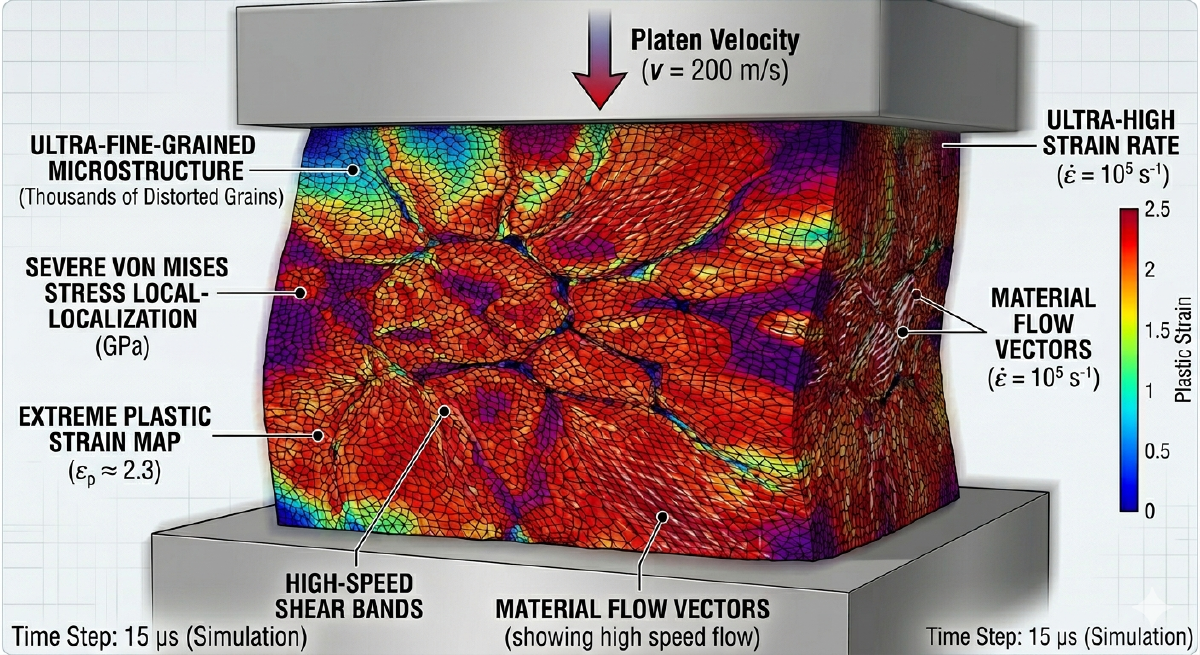

Overview#
Body-centered cubic (BCC) metals are among the most mechanically interesting crystalline solids to model. Unlike FCC metals, where slip occurs on well-defined {111}⟨110⟩ systems and the dislocation physics is relatively well understood, BCC plasticity is governed by thermally activated screw dislocation motion with non-planar core structures. This produces strong temperature and strain-rate sensitivity, and a persistent debate about which slip planes are actually active under different loading conditions.
Tantalum is a particularly clean test case for these questions. High-purity single crystals are available, its phase diagram is simple, and its dislocation physics has been studied extensively. These properties make it well-suited for the kind of orientation-resolved experimental and modelling work needed to actually resolve long-standing debates about BCC slip. The material also sees widespread use in applications where dynamic loading resistance matters, spanning spacecraft components, high-rate forming processes, and inertial confinement targets, making predictive models across strain rates from quasi-static to plate-impact conditions broadly useful.
The core challenge is that the constitutive models typically used for BCC metals at high rates were largely inherited from FCC crystal plasticity frameworks: fixed slip systems, similar hardening forms, similar parameter fitting approaches. At moderate rates and polycrystalline geometries this approximation can be acceptable. In single-crystal geometries and at rates above roughly 10^5/s, where the anisotropy of the response is most visible, these assumptions start to matter.
This body of work addresses that problem at multiple scales simultaneously: using molecular dynamics to understand the underlying dislocation physics, discrete dislocation dynamics to bridge from atomistic to continuum descriptions, and orientation-resolved plate-impact experiments to provide the most mechanistically demanding experimental tests.
Methodological Approach#
The multiscale strategy here is not simply sequential. Large-scale MD simulations of single-crystal tantalum access the relevant dislocation mechanisms directly at strain rates where experiment is hardest to interpret, revealing which slip systems activate, how screw versus edge segments move differently, and what the flow stress response looks like across crystal orientations. The MD data then informs the structure of a crystal plasticity constitutive model, rather than the model structure being assumed a priori and fit to macroscopic data.
The experimental complement is orientation-resolved plate-impact hole closure experiments, where single-crystal samples with precisely known crystallographic orientation are dynamically compressed and the mechanical response is monitored by in situ X-ray imaging. Varying orientation systematically probes the anisotropy of the dynamic strength response, a quantity that is highly sensitive to which slip systems are active and how their critical resolved shear stresses relate to one another. This makes it a much stronger test of model physics than polycrystal data can provide.
Papers#
Crystal Plasticity Model of BCC Metals from Large-Scale MD Simulations#
This paper developed a crystal plasticity model for BCC tantalum parameterized directly from large-scale quantum-accurate MD simulations. The central finding challenges a longstanding assumption: the standard notion of fixed, predetermined slip systems is inadequate for describing high-rate plasticity in tantalum at room temperature.
The MD data showed clearly that plasticity is better described by pencil glide, where dislocations move on the plane of maximum resolved shear stress rather than a prescribed crystallographic plane. The resulting CP model matched high-rate MD simulations across multiple crystal orientations and was also consistent with lower-rate experimental results. The result is a model grounded in atomistic physics rather than macroscopic curve fitting, with better predictive coverage across conditions. This provides the theoretical foundation for the experimental validation work that followed, and the MD-informed dynamic slip plane formulation is one of the most physically novel models in the ExaCMech library.
Citation: N. Bertin, R. Carson, V.V. Bulatov, J. Lind, M. Nelms. Acta Materialia 260, 119336, 2023. doi:10.1016/j.actamat.2023.119336 | Free PDF (OSTI)
High Strain-Rate Strength Response of Single Crystal Tantalum Through In-Situ Hole Closure Imaging Experiments#
This paper generated the experimental dataset needed to validate and constrain BCC crystal plasticity models at high rates. Plate-impact hole closure experiments were performed on high-purity single-crystal tantalum samples at strain rates above 10^5/s, with crystallographic orientation varied systematically relative to the loading axis. In situ high-resolution X-ray radiographic imaging at a synchrotron facility recorded the hole collapse in real time, allowing the dynamic strength to be inferred from the resistance to closure as a function of orientation and strain rate.
Orientation dependence is particularly diagnostic for crystal plasticity models: different slip system geometries produce different anisotropy signatures in the hole closure rate. Comparison against hydrocode predictions using simplified strength models established where those models fail and what a more physically complete CP model needs to capture. The dataset provides a demanding, orientation-resolved benchmark for the next generation of BCC dynamic strength models, relevant to any application area requiring high-rate single-crystal or strongly textured polycrystal predictions.
Citation: J. Lind, R.A. Carson, N. Bertin, M. Nelms. Materialia 37, 102219, 2024. doi:10.1016/j.mtla.2024.102219 | Free PDF (OSTI)
Enhanced Mobility of Dislocation Network Nodes and Its Effect on Dislocation Multiplication and Strain Hardening#
This paper addresses a more fundamental question: what do dislocation network nodes actually do, and what are the consequences for plastic flow? Nodes, the junctions where two dislocation lines meet to form a third, are commonly assumed to constrain dislocation motion. Comparing large-scale MD and discrete dislocation dynamics (DDD) simulations of BCC single crystals under identical loading conditions reveals that this picture is substantially incomplete.
The MD simulations uncover node behaviors invisible to DDD: nodes can facilitate dislocation motion through coordinated cross-slip mechanisms that only become accessible when dislocations are networked, rather than merely pinning them. These differences between MD and DDD predictions, in flow stress, dislocation density evolution, and microstructure development, identify specific physical mechanisms missing from current DDD frameworks. The paper also identifies asymptotic steady flow states, configurations in which flow stress and dislocation density reach stationary values under sustained straining, and shows that staged hardening can be understood as a transient trajectory toward attractor orientations in orientation space rather than a sequence of distinct mechanisms. A kinetic equation for dislocation density evolution derived from these observations naturally recovers Taylor hardening as the stationary condition, providing it a physical interpretation it previously lacked.
Citation: N. Bertin, W. Cai, S. Aubry, A. Arsenlis, V.V. Bulatov, R. Carson, et al. Journal of Materials Research and Technology, 2025. doi:10.1016/j.jmrt.2025.04.014 | Open Access (ScienceDirect)
Connections to Other Work#
The constitutive models developed here feed directly into ExaConstit through the ExaCMech library. The BCC MD-informed dynamic slip plane model in particular is one of the most structurally novel models in ExaCMech, tracking the active glide plane dynamically at each constitutive call rather than fixing it as a crystallographic constant. The sensitivity analysis work in the additive manufacturing section quantifies how uncertainty in CP model parameters propagates to property predictions. The experimental philosophy here, using orientation-resolved single-crystal data as the most diagnostic test of constitutive model physics, mirrors the intragranular deformation work applied to much more extreme loading conditions.