
Overview#
Fatigue is one of the grand challenges in engineering. The first published study appeared in 1837 on mining conveyor chains that failed in service. By the end of the 20th century, over 100,000 papers had been written on the subject, and the problem is still not solved. The reason is that fatigue failure depends on a wide range of interacting factors: residual stress, thermal processing, surface condition, environment, and most fundamentally, the microstructure of the material itself. The Aloha Airlines Flight 243 accident, where fatigue cracks in fuselage lap joints caused a section of the cabin roof to separate in flight, is one example among many that drove enormous investment in understanding how cracks initiate and grow under cyclic loading.
Within ductile pure metals, fatigue cracks typically do not initiate at pre-existing defects. They nucleate from localized plastic deformation. In FCC metals like copper, cyclic loading produces surface features called persistent slip bands (PSBs): narrow lamella-like structures, on the order of a micron wide, where plastic slip localizes and accumulates irreversibly over many cycles. The intrusions and extrusions that PSBs produce along free surfaces become Stage I crack initiation sites. The “persistent” part matters: these bands survive even after the surface is electropolished and re-tested, which tells you they reflect something deeply embedded in the local dislocation structure rather than just a surface artifact.
The problem is that almost all PSB research was done on single crystals, where the geometry is simple. In a polycrystalline material, which is what structural components actually are, grains interact mechanically with their neighbors, creating complex local stress and strain states that vary from grain to grain and within each grain. PSBs are much less commonly observed in polycrystals. The question is: are they absent, or just harder to find? My PhD thesis at Cornell proposed that in polycrystals, PSBs are better understood as persistent slip networks: three-dimensional structures of localized slip that cross grain boundaries and therefore do not present as the single-slip bands familiar from single-crystal experiments.
Pursuing that computationally required two things that did not fully exist. First, a rigorous way to compare what crystal plasticity simulations predict about intragrain deformation against what synchrotron diffraction experiments actually measure, without collapsing both into coarse grain averages that hide all the interesting physics. Second, a simulation formulation that handles the crystal lattice orientation correctly enough that localized slip can traverse grain boundaries in a physically meaningful way. This section covers both of those methodological developments, and the slip network detection framework that combined them.
Methodological Approach#
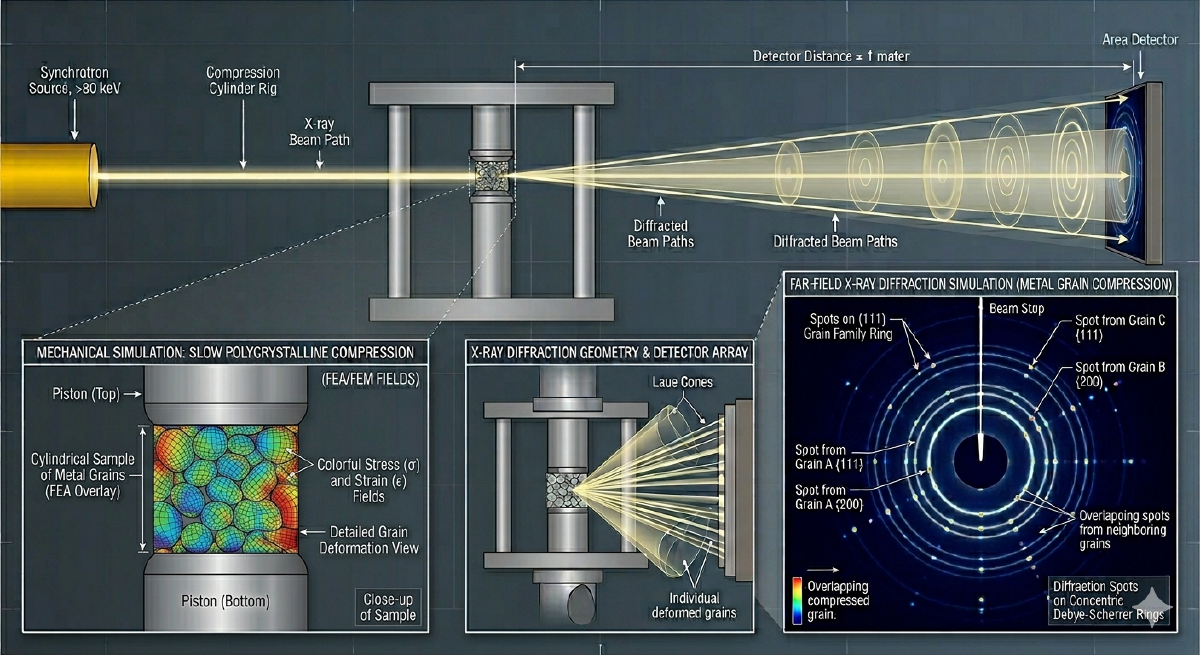
The experimental side was built in collaboration with Professor Matthew Miller’s group at Cornell, using far-field and near-field high-energy X-ray diffraction (HEXD) at the Cornell High Energy Synchrotron Source (CHESS) and the Advanced Photon Source at Argonne. Far-field HEXD gives grain-averaged lattice strains and orientations for thousands of grains simultaneously. Near-field HEXD gives spatially resolved orientation maps inside individual grains. Together, they provide both population statistics across the grain ensemble and direct spatial characterization of intragrain misorientation.
Simulations used FEpX, an open-source CPFE code from Cornell, extended for new heterogeneity metric computations and eventually for the LOFEM formulation. A virtual diffractometer synthesized HEXD signals from simulation output, enabling direct comparison. The intragrain heterogeneity metrics developed through this work are the translation layer that makes simulation-experiment comparison quantitative: scalar summaries of the spread of lattice misorientation or lattice strain within individual grains, extractable from both HEXD data and simulation fields.
Papers#
Characterizing Heterogeneous Intragranular Deformations in Polycrystalline Solids#
Cover Article: MSMSE July 2017This paper established the framework for quantitative simulation-experiment comparison at the intragrain scale, demonstrated on a precipitation-hardened copper alloy under completely reversed cyclic loading. Cyclic loading was the natural choice: reversed loading drives more dramatic rearrangement of the dislocation substructure than monotonic loading, producing stronger intragrain heterogeneity and making constitutive assumptions more discriminating.
The central contribution was a set of intragrain heterogeneity metrics applicable to both HEXD data and simulation fields, capturing the spread of stress, strain, and lattice misorientation within individual grains rather than just their averages. When isotropic and anisotropic hardening assumptions were compared against each other and against experiment, grain-averaged responses looked similar between the two models. The intragrain metrics revealed clear differences, and the anisotropic hardening model matched experiment more closely. That is the practical point: validating only against macroscopic stress-strain curves leaves you unable to distinguish between models that differ in ways that matter for grain-scale damage prediction.
Note: this paper predates my move to LLNL and no DOE open-access version exists. Access is available through IOP Publishing or via direct contact.
Citation: R. Carson, M. Obstalecki, M. Miller, P.R. Dawson. Modelling and Simulation in Materials Science and Engineering 25, 055008, 2017. doi:10.1088/1361-651X/aa6dc5
Formulation and Characterization of a Continuous Crystal Lattice Orientation Finite Element Method (LOFEM)#
Nye’s theory, the foundational connection between lattice curvature and geometrically necessary dislocation (GND) density, requires the lattice orientation to be a continuous field. Standard CPFE implementations do not satisfy this: orientations are stored independently at each integration point, making the field discontinuous at element boundaries within a grain. GND computations from standard output carry artificial contributions from those discontinuities. More importantly for slip network work, a discontinuous lattice orientation means slip cannot smoothly traverse a grain the way it physically must.
LOFEM fixes this by treating the lattice orientation as a genuine FE field, interpolated from nodal values with C0 continuity enforced across element boundaries within each grain. On copper polycrystals, imposing continuity measurably slows the rate at which crystallographic texture strengthens under loading, a physically meaningful change. LOFEM also allows slip to propagate across a grain in a topologically coherent way, which is a prerequisite for tracking slip networks using the graph methods developed in the thesis. The Nye tensor computed from LOFEM fields gives GND distributions that are both numerically clean and directly comparable to HR-EBSD measurements, connecting simulation output to widely used experimental characterization.
Citation: R. Carson, P.R. Dawson. Journal of the Mechanics and Physics of Solids 126, pp. 91–118, 2019. doi:10.1016/j.jmps.2019.02.006 | Free PDF (OSTI)
Estimation of Errors in Stress Distributions Computed in Finite Element Simulations of Polycrystals#
Before trusting intragranular simulation results, it is worth knowing how accurate they actually are. Classical FE error theory gives tight bounds for smooth problems, but CPFE simulations are inherently non-smooth: material properties jump at grain boundaries, stress concentrates where deformation localizes, and the regularity assumptions underlying classical estimates are violated.
This paper developed a practical error estimation approach using L2 projection to construct a smoothed stress field and using the difference between original and smoothed fields as a local error indicator. Applied to virtual alpha-phase titanium polycrystals with varied microstructural statistics, the results showed that errors peak near grain boundaries and at deformation band intersections, exactly where simulation output is most likely to be scrutinized. Samples with more varied grain sizes and less spherical grains are harder to resolve. A mesh that looks adequate for grain-average comparisons may be systematically underresolving intragrain fields in ways invisible at the macroscale but consequential for heterogeneity metrics.
Citation: K. Chatterjee, R.A. Carson, P.R. Dawson. Integrating Materials and Manufacturing Innovation 8(4), pp. 476–494, 2019. doi:10.1007/s40192-019-00158-z | Free PDF (OSTI)
Formation and Characterization of Slip Networks in a Polycrystalline Material Under Cyclic Loading#
Unpublished: PhD Thesis Chapter 4This is where the tools from the preceding papers come together. The persistent slip network hypothesis needed a computational method to actually find and track networks of localized slip across a polycrystal. The approach adapted connected component labeling from graph theory: a FE mesh can be represented as an undirected graph where nodes are vertices and shared-element connectivity forms edges, and connected component algorithms from image analysis then automatically identify all spatially contiguous regions above a given slip threshold. The same idea used to find objects in a binary image applied to volumetric simulation data.
To extend networks across grain boundaries, two slip transmission models were applied in post-processing: a simpler geometric model minimizing misorientation between slip plane normals, and a more realistic model using the full grain boundary normal and slip direction geometry. These models do not modify the simulation; they determine which active slip systems in neighboring grains are geometrically compatible enough to treat as connected when assembling the global network.
Applied to 456-grain OFHC copper polycrystals under fully reversed tension-compression loading, several things stood out. Slip networks formed in the first cycle and a subset persisted from cycle to cycle, directly analogous to the persistence that defines PSBs in single crystals, now showing up in a polycrystalline aggregate. Network formation did not require neighboring grains to lie on the same crystallographic fiber, meaning it is a genuinely topological phenomenon rather than a texture artifact. Potential fracture initiation sites were identified at grain boundaries where networks terminated incompatibly alongside significant effective stress differences, and in all cases these accounted for less than 1% of total grain boundary volume.
The most striking result for the experimental community: elastic intragrain heterogeneity metrics showed no statistically significant difference between grains containing slip networks and those that did not. The localization was happening in the plastic field before it registered in the elastic response detectable by diffraction. That prediction from 2018 was later independently confirmed experimentally roughly five years afterward through extensive EBSD studies on cyclically loaded materials.
Citation: R.A. Carson, P.R. Dawson. “Formation and Characterization of Slip Networks in a Polycrystalline Material Under Cyclic Loading.” Chapter 4 in Characterization of Deformation Heterogeneity During Cyclic Loading of Polycrystalline Materials Using Crystal Plasticity, PhD thesis, Cornell University, 2018.
Deformation Heterogeneity and Intragrain Lattice Misorientation in High Strength-Contrast, Dual-Phase Bridgmanite/Periclase#
This paper extended the intragrain heterogeneity framework to a geophysically important system: the bridgmanite/periclase aggregate that makes up much of Earth’s lower mantle. The two phases, orthorhombic bridgmanite (MgSiO3, mechanically strong) and cubic periclase (MgO, relatively weaker), have an extreme strength contrast that governs how deformation partitions between them, which is critical for interpreting seismic anisotropy and large-scale mantle flow.
Experimentally, the relevant conditions (25–135 GPa, above 2000 K) are only accessible in diamond anvil cells, which have far more limited mechanical control and measurement capability than HEXD on engineering metals. Simulation therefore plays a more central interpretive role. Using full-field CPFE with parameterized phase strength ratios, the study showed how strength contrast governs texture evolution, deformation partitioning, and intragrain lattice misorientation in each phase. It is also a demonstration that methodology developed for engineering fatigue applications transfers naturally to entirely different scientific domains: the physics of crystalline deformation is the same whether you are studying copper under cyclic loading or bridgmanite in a diamond anvil cell.
Citation: M. Kasemer, E. Zepeda-Alarcon, R. Carson, P. Dawson, H.-R. Wenk. Acta Materialia 189, pp. 284–298, 2020. doi:10.1016/j.actamat.2020.02.061 | Free PDF (OSTI)
Connections to Other Work#
The simulation-experiment comparison approach developed here threads through the rest of my research. The additive manufacturing work returns directly to synchrotron HEXD as the microscale validation tool: Knox et al. (2025) applies exactly this framework to AM Inconel 625. The CPFE methodology was eventually scaled to exascale hardware through the GPU computing work. The graph-theoretic slip network approach also points toward future directions: representing FE meshes as graphs opens the door to graph neural networks, topological data analysis, and other methods for finding structure in high-dimensional simulation data that go well beyond connected components.